阿凡达2
Colombian writer’s new work brings home country closer to Chinese audience_我的网站

一 |
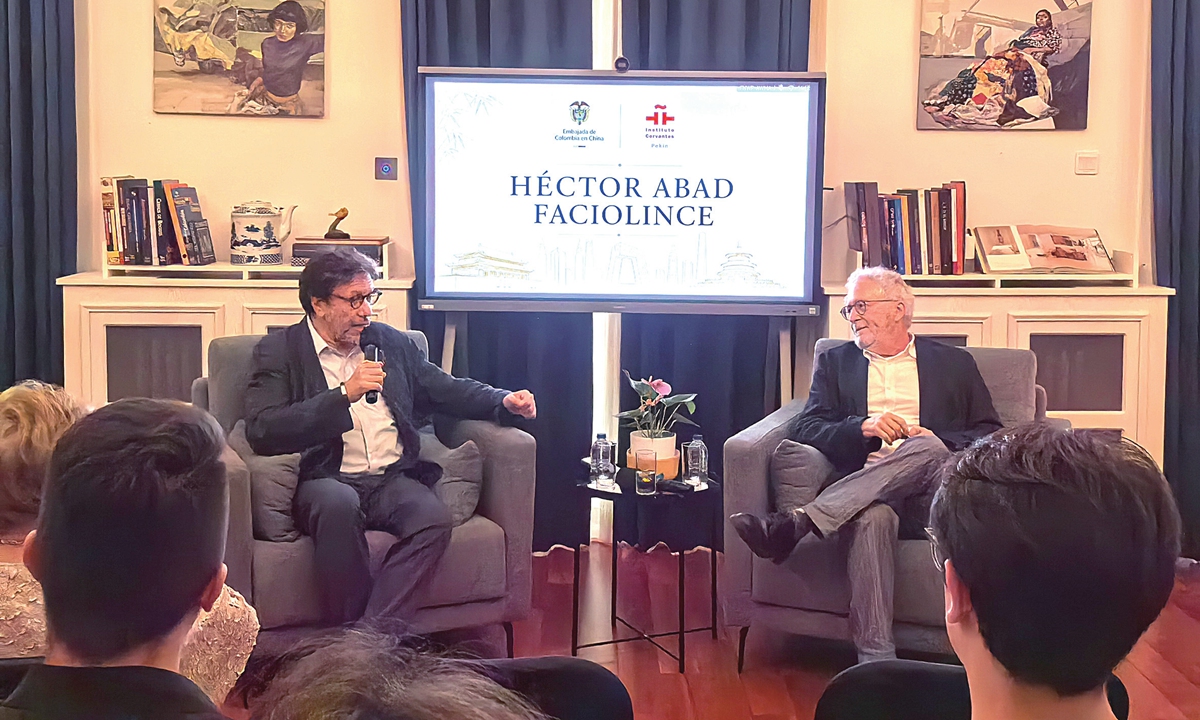
Santiago Gamboa, writer and minister counselor of the Embassy of Colombia in China, (left) and Héctor Abad Faciolince, a Colombian novelist, writer and journalist at a sharing session at the Embassy of the Republic of Colombia in China on August 18, 2026. Photo: Dong Feng/GT
The Embassy of the Republic of Colombia in China hosted a colloquium with Héctor Abad Faciolince, a Colombian novelist, writer and journalist. The writer shared on Tuesday his growth journey from a journalist to achieve his dream as a writer, his observation of the Colombian society and his impression about the changes in China.
In a fully packed hall, Minister Plenipotentiary Jose Fernando Bermúdez Cendales said in his opening remarks that the event is part of an initiative to bring Colombian culture closer to the Chinese public while simultaneously creating new spaces for dialogue and exchange between the two countries.
Bermúdez said that Abad's visit to China offers a particularly valuable opportunity to showcase the richness of our literature and to strengthen the cultural and human bridges connecting Colombia and China.
The session, chaired by Santiago Gamboa, writer and minister counselor of the Colombian Embassy, focused on the career and body of work of Abad and in particular,
El olvido que seremos (Oblivion: A Memoir).
Abad's book is a seminal work of contemporary Colombian literature in which personal and family memory engage deeply with Colombia's recent history. Its translation into Chinese allows this story to reach new readers and represents an extraordinary opportunity to bring both societies closer together through literature, per some commentators.
"We hope this gathering will be an open conversation among cultures, readers, and experiences, and a new expression of the friendship that Colombia and China continue to build," said Bermúdez.
Abad, one of the most important voices in contemporary Latin American literature, shared with the Global Times that this is his second trip in China. The last time he visited the country was two decades ago.
This time, in his eyes, China has changed a lot. In many ways, the country stands for the future of the world.
Abad said he is surprised to see how much Chinese people are depending on the electric devices and network to communicate in a virtual world, and said that he felt "like an alien."
Talking about his interaction with readers in Shanghai, Abad smiled, saying that the readers selected some phrases from his book and asked him to write down as part of the autography and signature for them.
In his book,
El Olvido Que Seremos (The Oblivion We Will Be), which is acclaimed as a "love letter from a son to his father," is not only a deeply affectionate look back at familial bonds but also a courageous attempt to defy oblivion.
Rooted in true events,
The Oblivion We Will Be chronicles the life of his own father. Abad noted that his father was killed in August 1987 - nearly forty years ago.
In the Western literary tradition, a father is often portrayed as a distant or even negative figure. His father, however, was "totally different - a man of love and deep sense of responsibility in both the public sphere and his family life."
Such image of a benevolent, non-authoritarian father has impressed his Chinese readers as well, he said.
As a physician, Abad's father dedicated his life to addressing fundamental issues affecting people's well-being, such as drinking water quality and public health, steadfast in the belief that the world could be made better through action.
Abad's work addresses themes such as memory, violence, inequality, and the human condition, deeply marked by the murder of his father, an event that inspired his most iconic book, The Oblivion We Will Be was published in Chinese by Writer's Publishing House in Beijing in July.
。 南海海域的风云变幻,总是牵动着世界的目光。

二 | 日前,我方正式对外发布公告,宣布将在南海粤西外海一片海域划定禁航区,为期五天,从8月24日开始。这看似常规的操作,却引发了外界诸多猜测:究竟发生了什么,需要如此大规模的封锁海域?公告上给出的解释简单明了:为进行演练,其中包含多项实弹射击项目。目的直白,保障国内外民用船只的安全。 几乎就在公告发布的同时,南海另一片海域也骤然笼罩在禁航的阴影之下。北京时间8月23日,我方再次发布公告,宣布海南岛东南侧的南海海域将迎来为期三天的禁航期。

三 | 同样的理由,实弹射击演练。短短二十四小时内,中国南海连续爆发了两场实弹军演,这是否预示着南海局势的升级?仔细分析,答案恰恰相反。

四 | 这连同后续的两场演习,更像是一场宣告:围绕南海主权角逐的长期博弈,已经渐入尾声,乃至可以说已经尘埃落定。 回顾这段时间发生在南海的事件,会发现这并非一次突发的冲突,而是一场精心设计的博弈,其过程可以清晰地划分为三个阶段。起初,菲律宾急于施压,于8月21日派遣三架飞机未经许可侵入黄岩岛领空。

五 | 值得玩味的是,这三架飞机都是非武装侦察机,明显并非为了正面冲突而来,而是另有所图:蓄意制造舆论导向,企图博取同情和支持。 面对菲律宾的试探,我方果断出击,却采取了一种颇为巧妙的策略,并非简单的驱离,而是兵分三路,出其不意地掌控局势。

六 | 高空之上,战斗机威慑震慑,全程避免与菲方飞机直接接触,切断其碰瓷的机会。低空之下,直升机负责近距离跟踪,通过无线电喊话和伴飞的方式,直接有效驱离。而海面之上,长期部署在黄岩岛附近的军舰和海警船艇,则发挥着情报支援和海面管控的双重作用,构筑起一张严密的防御网。 在多路夹击之下,菲律宾的几架小飞机彻底无所遁形,最后只能灰溜溜地撤离。然而,菲律宾人并未就此罢休,不到48小时后,他们再次发起挑战,组织了一场号称七国联军的南海多边联合巡航。然而,仔细一看,真正参与巡航的国家,不过是澳大利亚和加拿大两支力量,澳大利亚出动了护卫舰和海上巡逻机,而加拿大则仅派出了海军力量。

七 | 这充分说明,菲律宾并非没有分寸,小马科斯政府深知,仅凭几架飞机根本无法撼动我方在南海的实力,更没有能力与我方海警抗衡。于是,菲律宾另辟蹊径,试图通过域外力量给自己壮胆。 然而,人多势众在中国面前,并不能带来任何优势。

八 | 我方随即采取行动,连续发布了两道海域禁航令,并在南海展开了实弹射习演练。这一举动背后的信号异常清晰:菲律宾也好,澳大利亚和加拿大也罢,如果真有胆量,就等我们真正拉开架势后再来南海巡航。结果不出所料,后续的巡航行动很快便偃旗息鼓,归于平静。

九 | 我军不费一兵一卒,仅仅通过两场实弹演习,就成功化解了菲律宾酝酿已久的区域风暴,南海风云,也终将归于平静。

十 | 返回,查看更多。
Current article:http://gyw1goy.zhuaicaisaanzhenshunnaiwei.bond/e45/nopk.html
Published on:06:14:23